
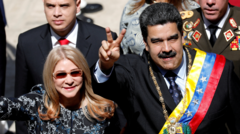
What we know about Maduro's capture
In a stunning development, Venezuelan President Nicolás Maduro and his wife Cilia Flores have been taken into custody, the White House has confirmed. The dramatic arrest took place in what President Donald Trump described as "a house that was more like a fortress" in an undisclosed location.
The circumstances surrounding Maduro's capture remain murky, but the implications of this development could be far-reaching for the troubled South American nation. As the international community grapples with the news, here's what we know so far.
The arrest
According to a statement from the White House, Maduro and his wife were apprehended by a joint operation involving Venezuelan security forces and international allies. The specific location of the raid has not been disclosed, but Trump praised the efforts of those involved, saying the operation was "very complex" and "went off beautifully."
Maduro has long been the subject of intense scrutiny and pressure, both domestically and internationally. His authoritarian rule and the severe economic crisis plaguing Venezuela have drawn widespread condemnation, with many calling for his ouster. The arrest represents a significant blow to his embattled regime.
Maduro's rise to power
Nicolás Maduro first came to prominence as the hand-picked successor of Venezuela's former president, Hugo Chávez. Following Chávez's death in 2013, Maduro assumed the presidency, promising to continue the socialist "Bolivarian Revolution" that had defined his predecessor's rule.
However, Maduro's tenure has been marked by a series of crises and controversies. Under his leadership, Venezuela has descended into an economic and humanitarian disaster, with hyperinflation, shortages of food and medicine, and a mass exodus of its citizens. Maduro has been accused of rigging elections, cracking down on dissent, and consolidating power in a manner that many have denounced as dictatorial.
The international response
Maduro's arrest has been met with a range of reactions from the international community. The United States, which has long been a vocal critic of Maduro's regime, has applauded the operation, with President Trump calling it a "big day" for the Venezuelan people.
Other regional powers, such as Colombia and Brazil, have also welcomed the news, seeing it as a potential turning point in the country's ongoing political and economic crisis. The European Union, which has imposed sanctions on Maduro and his allies, has expressed cautious optimism, calling for a peaceful transition to democracy.
However, Maduro still retains the support of some allies, including Russia and Cuba, who have condemned the arrest as a violation of Venezuela's sovereignty. These countries have vowed to continue supporting Maduro's government, further complicating the geopolitical landscape.
The road ahead
With Maduro now in custody, the focus shifts to the future of Venezuela and the path forward. The arrest presents both opportunities and challenges for the country's opposition, who have long been working to oust Maduro from power.
On the one hand, Maduro's removal could pave the way for a transition to a more democratic and stable government, potentially addressing the pressing economic and humanitarian crises. However, the power dynamics within Venezuela remain complex, and there is a risk of further political instability and even violence as various factions jockey for control.
Additionally, the fate of Maduro and his close associates will be a crucial factor in shaping the country's future. Will he face prosecution for his alleged abuses of power and human rights violations? How will his supporters react to his downfall? These questions will need to be carefully navigated in the weeks and months ahead.
Ultimately, the capture of Nicolás Maduro represents a significant turning point in the long-standing crisis in Venezuela. While the immediate implications are still unfolding, the potential for a new chapter in the country's history is palpable. However, the road to recovery and reconciliation will undoubtedly be arduous, requiring the sustained commitment and cooperation of both domestic and international actors.
📰


