
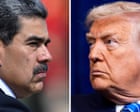
Why has the US attacked Caracas and captured Venezuela's president?
The United States has launched a dramatic and unprecedented military intervention in Venezuela, carrying out airstrikes in the capital Caracas and capturing the country's president, Nicolás Maduro, in a stunning escalation of the long-simmering tensions between the two nations.
The attack, which occurred in the early hours of Friday morning, saw a series of explosions rock Caracas as US forces launched coordinated air strikes across the city. Shortly afterwards, President Trump announced that Maduro and his wife Cilia Flores had been apprehended by US troops and flown out of the country.
Speaking from the White House, US Attorney General Pam Bondi stated that Maduro had been taken into custody and would face trial in the United States on charges of corruption, human rights abuses, and drug trafficking. Bondi claimed that the operation had been months in the planning and was the culmination of a sustained US military campaign against the Maduro government.
The sudden and dramatic nature of the intervention has sent shockwaves around the world, with US allies and adversaries alike expressing alarm and concern. Many are questioning the legality and morality of the US's actions, while also worrying about the potential for further escalation and instability in the volatile region.
To fully understand the significance of this event, it's important to examine the longstanding tensions between the US and Venezuela, as well as the broader political and economic context that has led to this dramatic showdown.
The relationship between the United States and Venezuela has been characterized by mutual distrust and hostility for years, dating back to the rise of Hugo Chávez and the Bolivarian Revolution in the late 1990s. Chávez, a vocal critic of US imperialism and neoliberal economic policies, sought to position Venezuela as a counterweight to American influence in Latin America, forging close ties with other left-wing governments in the region.
This ideological and geopolitical clash has only intensified under Maduro's leadership, as the Venezuelan government has cracked down on dissent, held disputed elections, and overseen an economic crisis that has plunged the country into hyperinflation and widespread shortages of food and medicine. The US has responded by imposing a raft of sanctions on Venezuelan officials and institutions, while also providing support to the country's opposition forces.
In recent years, the Trump administration has taken an increasingly aggressive stance towards Venezuela, recognizing opposition leader Juan Guaidó as the legitimate president and repeatedly threatening military intervention. The administration has accused Maduro of being a "dictator" and a "socialist tyrant," while also alleging that his government is deeply involved in drug trafficking and other illicit activities.
The US's actions in Caracas this week represent a dramatic escalation of this confrontation, going beyond sanctions and rhetorical threats to a full-blown military assault on the Venezuelan state. The capture of Maduro is a stunning blow to the Bolivarian Revolution, which has long seen Venezuela as a bulwark against US imperialism in the region.
However, the move is also fraught with risk and uncertainty. Venezuela's government and its allies in countries like Cuba and Russia have already denounced the intervention as an illegal act of aggression, and there are fears that it could trigger a broader regional conflict. Additionally, the fate of Maduro and the future of Venezuela's political system remain unclear, with the possibility of a protracted power struggle or even civil war looming large.
Ultimately, this latest development in the US-Venezuela standoff represents a dangerous and unpredictable moment in the history of the region. The ramifications of the US's actions will be felt for years to come, potentially reshaping the geopolitical landscape of Latin America and beyond. As the world watches events unfold in Caracas, it is clear that the crisis in Venezuela is far from over, and the road ahead is fraught with uncertainty and risk.
📰


