
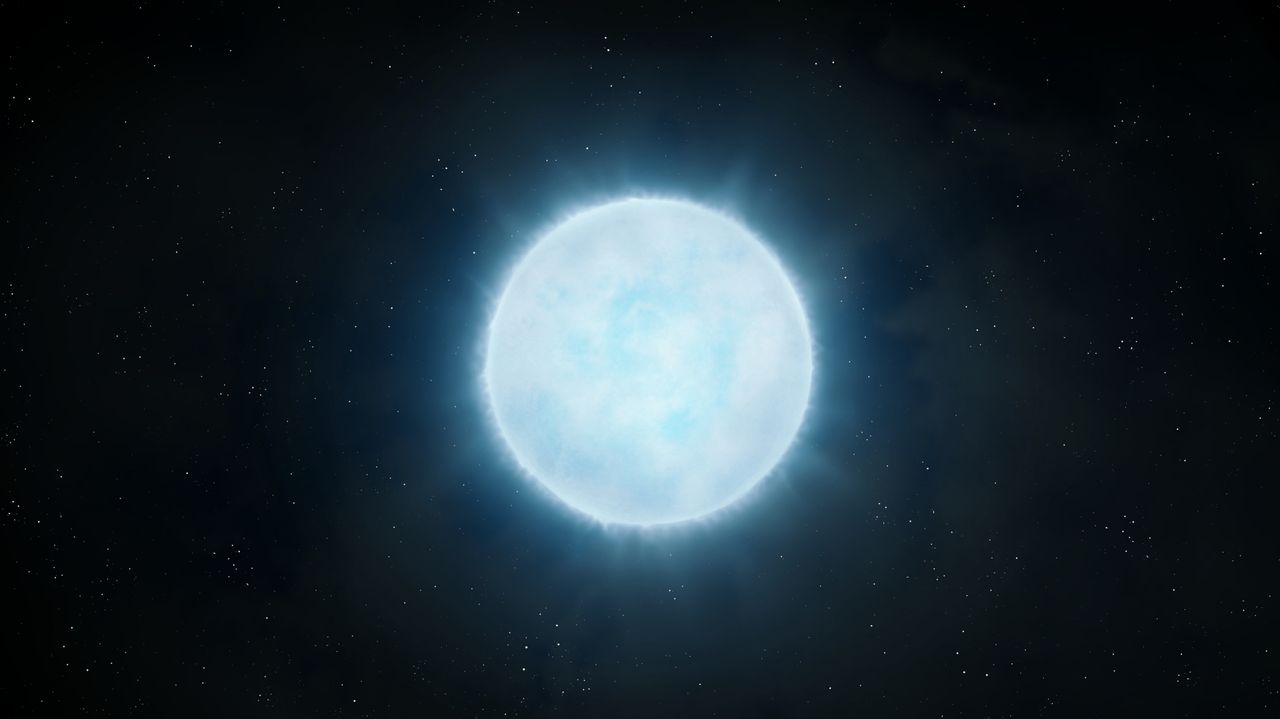
What Old, Dying Stars Teach Us About Axions as a Candidate for Dark Matter
For decades, physicists have been searching for the elusive substance known as dark matter - the mysterious, invisible material that appears to make up a significant portion of the universe. One of the prime candidates to explain this cosmic conundrum is the axion, a hypothetical subatomic particle that could possess unique properties allowing it to be the missing link in our understanding of the universe.
Recent observations of old, dying stars have provided intriguing new insights into the potential nature of axions and their role as a dark matter candidate. By studying the behavior of these ancient celestial bodies, scientists are gaining valuable clues about the fundamental characteristics of axions and how they may interact with normal matter.
The Enigma of Dark Matter
Dark matter is one of the great unsolved mysteries of modern astrophysics. Astronomers have long known that the matter we can directly observe - the stars, galaxies, and other luminous objects in the cosmos - accounts for only a small fraction of the total mass in the universe. The rest appears to be made up of an invisible, undetectable substance that can only be inferred from its gravitational effects on the visible matter around it.
Despite decades of research and increasingly sophisticated experiments, the true nature of dark matter remains elusive. Numerous theories have been proposed to explain it, ranging from undiscovered subatomic particles to modifications to our understanding of gravity. One of the most promising candidates is the axion, a hypothetical particle first proposed in the 1970s as a byproduct of a theory intended to resolve issues with the Standard Model of particle physics.
Axions as Dark Matter Candidates
Axions are intriguing because they possess several properties that make them well-suited as dark matter particles. For one, they are predicted to be incredibly lightweight, with a mass potentially as small as a billionth the mass of an electron. This would allow them to exist in vast numbers throughout the universe without being directly detectable by current technologies.
Additionally, axions are thought to interact with normal matter and energy only very weakly, which would explain why dark matter has been so difficult to observe directly. This "shyness" is a key feature that sets axions apart from other proposed dark matter candidates, such as the more massive and interactive weakly interacting massive particles (WIMPs).
The hunt for axions has ramped up in recent years, with scientists around the world racing to build specialized detectors capable of potentially identifying these elusive particles. However, directly detecting axions remains an immense challenge, as their interactions with normal matter are predicted to be vanishingly small.
Insights from Stellar Observations
This is where the study of old, dying stars comes into play. As stars reach the end of their lives, they can provide valuable clues about the properties of axions and how they might behave in the universe.
One key piece of evidence comes from observations of red giant stars - massive, bloated stars nearing the end of their fuel supply. According to theoretical models, the presence of axions could subtly influence the cooling rate of these stars, causing them to shed their outer layers more rapidly than expected.
Remarkably, recent observations of red giants have revealed that they are, in fact, cooling and shedding their outer envelopes faster than predicted by standard stellar evolution models. This has led some scientists to suggest that the presence of axions, streaming out of the star's core, could be responsible for this unexpected behavior.
"If axions exist and have the properties we think they have, then they should be streaming out of the cores of these old, dying stars," explained theoretical physicist Joshua Frieman of the University of Chicago and Fermilab. "And that would be causing them to cool a little bit faster than standard models predict."
Further evidence comes from the study of white dwarfs - the ultra-dense, collapsed cores of stars that have shed their outer layers. Observations of these stellar remnants have also hinted at the possible presence of axions, with some white dwarfs appearing to cool more rapidly than expected.
Implications and the Future of Axion Research
The potential implications of these stellar observations are profound. If the hints of axions detected in red giants and white dwarfs are confirmed, it would lend significant support to the idea that axions could indeed make up a substantial portion of the universe's dark matter.
Moreover, a better understanding of axions and their properties could open up new avenues of research into the fundamental nature of the cosmos. Axions may not only provide clues about dark matter, but they could also shed light on other unsolved mysteries, such as the origin of the universe's large-scale structure and the behavior of matter and energy at the most extreme conditions.
"Axions would be a very different kind of dark matter particle than the ones we've traditionally thought about," Frieman said. "If axions turn out to be the dark matter, it would really revolutionize our understanding of the universe."
As the search for dark matter continues, the study of old, dying stars will likely remain a crucial component of the effort to unravel the axion's secrets. With each new observation and theoretical insight, scientists are inching closer to solving one of the greatest puzzles in modern astrophysics - and potentially rewriting our understanding of the universe in the process.
📰


