
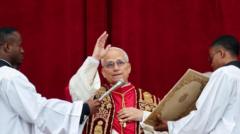
Pope Leo's Christmas Address Calls for Courage to End Ukraine War
In his first Christmas address as the leader of the Catholic Church, Pope Leo delivered a powerful message urging the international community to find the "courage" to bring an end to the ongoing conflict in Ukraine. Speaking to a packed St. Peter's Square at the Vatican, the pontiff lamented the suffering of the Ukrainian people and called for renewed efforts to achieve a peaceful resolution to the crisis.
The pope's remarks came amid a backdrop of heightened global tensions and an ongoing humanitarian crisis in Ukraine. Since Russia's invasion of the country in February 2022, the conflict has claimed tens of thousands of lives, displaced millions of civilians, and sparked the largest refugee crisis in Europe since World War II. In his address, Pope Leo acknowledged the gravity of the situation, describing the war as a "senseless act of aggression" that has caused immense pain and devastation.
"In this Christmas season, when we celebrate the birth of our Savior and the promise of peace on earth, I appeal to all those with the power to make a difference: find the courage to end this war," the pope said. "The people of Ukraine deserve to live in security and dignity, free from the shadows of conflict and destruction."
Beyond the situation in Ukraine, Pope Leo also used his Christmas message to draw attention to the plight of the Palestinian people, lamenting the "difficult conditions" they continue to face. He called for a renewed commitment to finding a just and lasting solution to the Israeli-Palestinian conflict, which has been a source of ongoing tension and violence in the region.
The pope's remarks were widely seen as a direct challenge to the world's political and military leaders, who have struggled to find a diplomatic solution to the crises in Ukraine and the Middle East. In recent months, efforts to negotiate a ceasefire or peace agreement in Ukraine have been hampered by the entrenched positions of the parties involved, as well as the broader geopolitical tensions between Russia and the West.
Despite the formidable obstacles, Pope Leo expressed hope that the "light of Christmas" could inspire the courage and compassion needed to break the cycle of violence and seek a peaceful resolution. He urged world leaders to put aside their differences and work together towards a future of justice and reconciliation.
"This is a time for us to reflect on the true meaning of the season – the birth of our Savior, who came to bring peace and goodwill to all people," the pope said. "Let us heed his call to be peacemakers, to show kindness and generosity to those in need, and to work tirelessly to end the conflicts that continue to ravage our world."
The pope's Christmas address was widely praised by religious and political leaders around the world, who commended his moral leadership and call for action. Many expressed hope that his words would galvanize the international community to redouble its efforts to find a peaceful solution to the crises in Ukraine and the Middle East.
At the same time, some critics argued that the pope's message lacked specific policy proposals or a clear roadmap for achieving peace. They emphasized the need for more concrete steps and diplomatic initiatives to address the root causes of the conflicts and pave the way for lasting solutions.
Nonetheless, Pope Leo's Christmas address was widely seen as a significant moment in his young papacy, as he sought to position the Catholic Church as a moral voice on the world stage and a champion of peace and reconciliation. In the months and years ahead, the international community will be closely watching to see if his call for courage and compassion translates into tangible progress towards ending the devastating conflicts that continue to plague our world.
📰


