
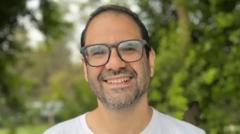
Egyptian Dissident Seeks Asylum in UK, Sparking Controversy
In a controversial move, the UK government is facing calls to deport Egyptian dissident Alaa Abdel Fattah, who arrived in Britain on Friday after a travel ban imposed by the Egyptian authorities was lifted. Abdel Fattah, a prominent pro-democracy activist and software engineer, has been a thorn in the side of the Egyptian regime for years, and his case has drawn international attention to the country's crackdown on dissent.
Abdel Fattah's journey to the UK has been a long and arduous one. He was first arrested in 2011 during the Arab Spring protests that toppled former president Hosni Mubarak, and has since spent much of the past decade behind bars, facing a litany of charges that his supporters have dismissed as politically motivated. In 2019, he was sentenced to five years in prison for spreading "false news," a charge that rights groups have condemned as a blatant attempt to silence him.
Despite his imprisonment, Abdel Fattah has remained a vocal critic of the Egyptian government, using his writing and social media presence to draw attention to the country's human rights abuses and the plight of political prisoners. His case has become a rallying cry for activists and human rights organizations around the world, who have called for his release and for the Egyptian government to respect basic civil liberties.
Now, with Abdel Fattah's arrival in the UK, the British government finds itself caught in the middle of a complex geopolitical and humanitarian crisis. On the one hand, the UK has a long-standing alliance with Egypt, which is seen as a key strategic partner in the Middle East. The two countries have deep economic and security ties, and the British government has been reluctant to criticize the Egyptian regime too strongly in the past.
On the other hand, the UK has also positioned itself as a champion of human rights and democracy, and has pledged to stand up for dissidents and political activists around the world. Abdel Fattah's case presents a significant test of these principles, and the government's response will be closely watched by human rights groups and the international community.
Already, some conservative members of the UK parliament have called for Abdel Fattah to be deported back to Egypt, arguing that his presence in the country poses a security risk and could damage relations with a key ally. This view is likely to be met with fierce opposition from human rights advocates and pro-democracy activists, who see Abdel Fattah's asylum claim as a crucial test of the UK's commitment to protecting those who speak out against authoritarian regimes.
The situation is further complicated by the fact that Abdel Fattah is not the only Egyptian dissident seeking refuge in the UK. In recent years, a number of other high-profile activists and journalists have fled Egypt and sought asylum in Britain, seeking to escape the country's increasingly repressive political climate.
This influx of dissidents has put pressure on the UK government to navigate a delicate balancing act between its strategic interests in the Middle East and its stated commitment to human rights. The Abdel Fattah case is likely to be a crucial test of the government's ability to strike this balance, and the outcome could have significant implications for the UK's standing on the global stage.
Ultimately, the fate of Alaa Abdel Fattah will be closely watched by observers around the world, as it represents a microcosm of the broader struggle between authoritarian regimes and those who dare to challenge them. The UK's response to this case will be a litmus test of its values and principles, and will shape perceptions of the country's commitment to democracy and human rights in the years to come.
📰


