
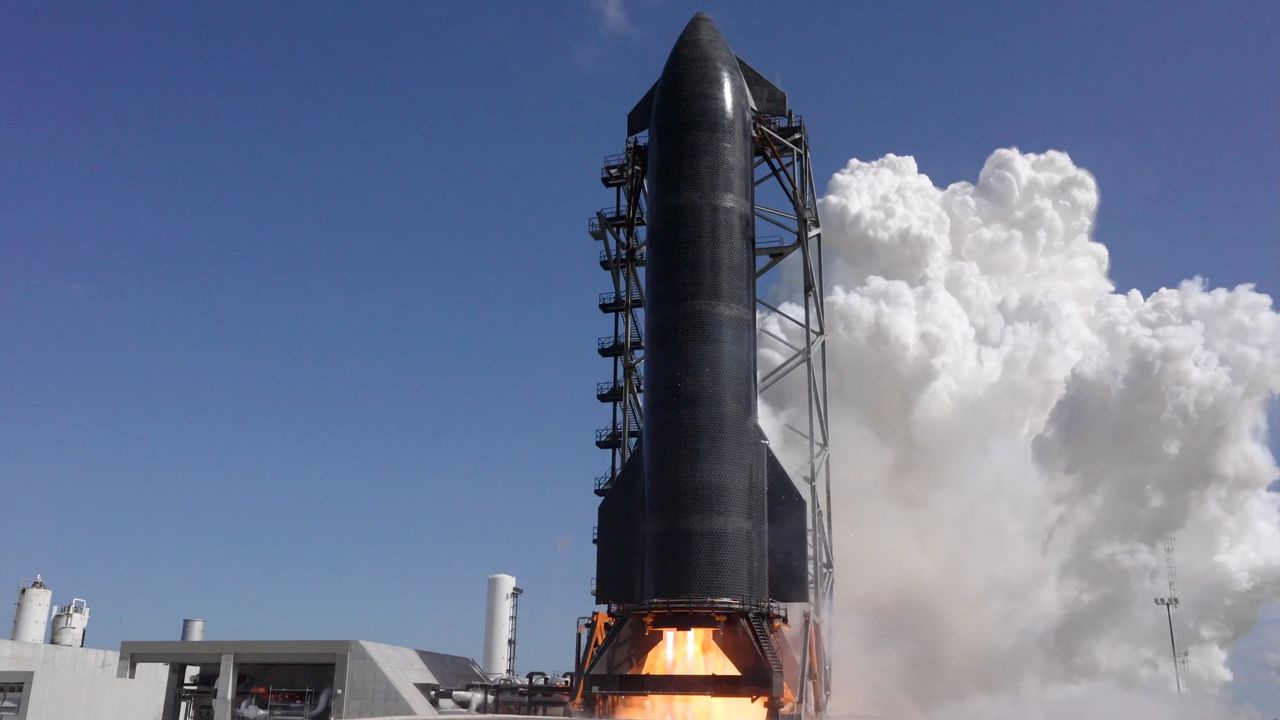
Less than a week after its last test, SpaceX's latest Starship spacecraft went back to the stand for engine checkouts ahead of a coming test flight.
The upper stage for SpaceX's giant Starship rocket, referred to simply as "Ship" — Ship 40, in this case — underwent a static-fire test of all six of its Raptor engines at the company's Massey site in Starbase, Texas. Ship 40 is in line for the 13th test flight of a fully stacked Starship, which is expected within the next month or so.
SpaceX posted a video of the engine test to its X account on Thursday (July 2), showing several angles of the ignition sequence and all six engines (Ship is equipped with three sea-level and three vacuum-optimized Raptors) firing to simulate flight-like conditions on the vehicle.
Starship 60-second static fire ahead of the thirteenth flight test pic.twitter.com/HKZkaXo7WNJuly 2, 2026
Ship 40 conducted its first-ever static fire last week, lighting a single Raptor for about 15 seconds. This more recent test involved all six Raptors and lasted a full minute, according to SpaceX.
Ship 40 will take part in the second "Version 3" (V3) Starship launch; SpaceX debuted the updated rocket prototype during a test flight on May 22. That mission went smoothly, for the most part, but it wasn't a complete success; the rocket's Super Heavy booster failed to maneuver its way to a soft ocean splashdown as planned. So the upcoming Flight 13 will likely mirror much of the flight path and mission objectives as Flight 12, including relighting one of Ship's Raptor engines in space.
Starship is SpaceX's super-heavy lift rocket, designed for seamless landing and reuse. The more capable V3 stands 408 feet (124.4 meters) tall — about 5 feet (1.5 m) taller than V2 — and is the biggest, most powerful rocket ever to fly.
Once development is complete and the vehicle is fully operational, SpaceX has big plans for the rocket, including the expansion of its Starlink satellite-internet network in low Earth orbit and landing NASA astronauts on the moon as a part of the Artemis program. The spacecraft will also be capable of delivering heavier payloads to orbit than any other rocket in history.
The success of this most recent engine test puts SpaceX one step closer to Starship Flight 13. Next steps ahead of that launch will include rolling the mission's Super Heavy booster to the pad at Starbase for engine tests of its own. Super Heavy sports 33 Raptor engines at its business end, which produce nearly 20 million pounds of thrust at liftoff. Should Super Heavy's static fire tests go smoothly, Flight 13 could happen as early as August.
📰


