
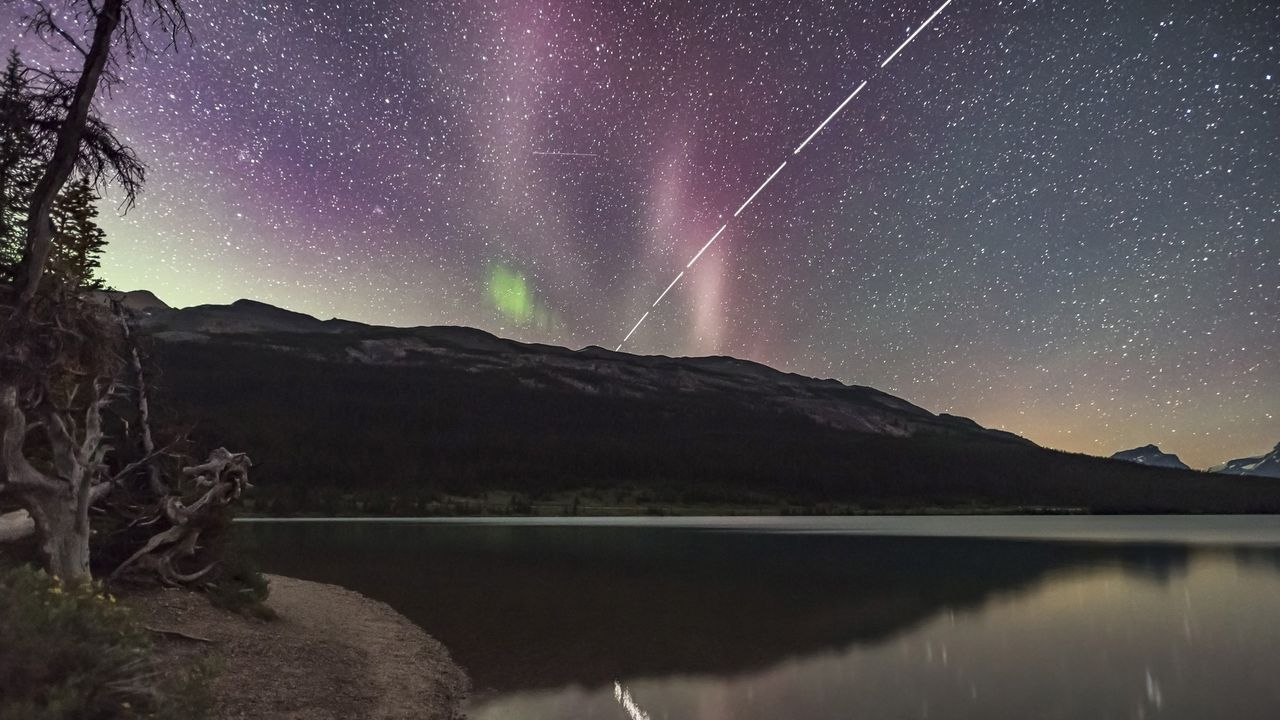
Santa's Sleigh or the International Space Station? How to Spot a Bright Christmas Flyby on Dec. 24 and 25
As the Christmas season approaches, stargazers across North America and Europe may be treated to a celestial sight that could be mistaken for Santa's sleigh soaring through the night sky. However, this bright, silent light is actually the International Space Station (ISS) making one of its regular flybys over our planet.
The ISS, a remarkable feat of international collaboration and engineering, orbits the Earth at an average altitude of about 400 kilometers (250 miles), circling our planet every 90 minutes. While the space station is not visible to the naked eye during the day, it can sometimes be spotted as a bright, moving point of light in the night sky, especially around the time of certain scheduled flybys.
This year, the ISS is set to make a particularly notable appearance on the evenings of December 24 and 25, providing a unique opportunity for skywatchers to catch a glimpse of the orbiting laboratory as they gather to celebrate the holidays.
"The ISS is one of the brightest objects in the night sky, and during certain times of the year, it can be easily visible to the naked eye," explains Dr. Michelle Thaller, an astronomer and science communicator at NASA. "This is especially true around the holidays, when the station's path happens to align with the traditional Christmas Eve and Christmas Day festivities."
To catch a glimpse of the ISS this holiday season, stargazers should look towards the western or northwestern horizon shortly after sunset on December 24 and 25. The space station will appear as a bright, steadily moving point of light, easily distinguishable from the twinkling stars and planets in the night sky.
"The key is to look for a bright, non-blinking object that is moving across the sky at a steady pace," Thaller says. "Unlike an airplane, which has blinking lights and can change direction, the ISS will maintain a straight, predictable course as it orbits the Earth."
The visibility of the ISS during these flybys will depend on the weather conditions and the observer's location, but Thaller notes that the space station should be easily visible to most skywatchers in North America and Europe, weather permitting.
"The best viewing conditions will be on clear nights, with minimal cloud cover and light pollution," she says. "Those in more rural or suburban areas, away from the glare of city lights, will have the best chance of spotting the ISS as it passes overhead."
The timing of the flybys is also crucial, as the ISS will only be visible for a few minutes during each pass. On December 24, the space station is expected to make its closest approach to parts of the eastern United States and Canada around 6:15 pm EST, while on December 25, the best viewing opportunities will likely be in western Europe, with the ISS reaching its highest point in the sky around 6:00 pm GMT.
"It's important to be ready and focused on the right part of the sky at the right time," Thaller advises. "The ISS moves quickly, so you'll want to be on the lookout for that bright, steady light in the moments leading up to the peak of the flyby."
While the sight of the ISS zipping across the Christmas sky may be a novel experience for many, the space station's presence in orbit is actually a year-round phenomenon. Launched in 1998, the ISS has been continuously inhabited by rotating crews of astronauts and cosmonauts from around the world, conducting a wide range of scientific experiments and technological demonstrations that have expanded our understanding of the space environment and pushed the boundaries of human exploration.
"The International Space Station is an incredible engineering and scientific achievement, a true testament to the power of international cooperation," Thaller says. "And to be able to catch a glimpse of this orbiting laboratory during the holiday season is a wonderful reminder of the progress we've made in space exploration, and the ongoing efforts to push the boundaries of what's possible."
For those lucky enough to spot the ISS during its Christmas Eve or Christmas Day flybys, the experience is likely to be a memorable one, offering a unique perspective on the wonders of space and the human endeavors that have made it possible.
"Seeing the ISS move silently across the night sky, knowing that it's home to a crew of astronauts from different nations working together for the betterment of humanity – that's a truly special sight," Thaller says. "It's a moment that can inspire wonder, awe, and a renewed appreciation for the incredible achievements of space exploration."
So as you gaze up at the Christmas sky this year, keep an eye out for that bright, steady light traversing the heavens. It may just be Santa's sleigh – or it could be the International Space Station, reminding us that the wonder of space exploration is truly a gift that keeps on giving.
📰


