
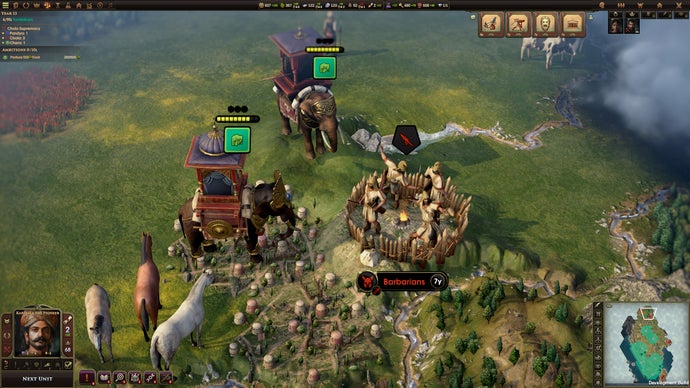
Hooded Horse's 'Old World' Expands into the Empires of the Indus
Fans of the acclaimed pre-modern 4X strategy game 'Old World' have reason to rejoice, as developer Hooded Horse and studio Mohawk Games have announced a substantial new expansion, titled 'Empires of the Indus.' This latest DLC will transport players to the ancient civilizations that thrived along the banks of the Indus River, in what is now modern-day Pakistan and northern India.
'Old World' has steadily built a devoted following since its initial release in 2020, praised for its nuanced take on 4X gameplay that blends historical authenticity with engaging mechanics. The base game allowed players to guide the rise of various ancient Mediterranean and Near Eastern cultures, from the Egyptians to the Greeks to the Persians. With 'Empires of the Indus,' the game's scope expands to encompass the equally rich and influential societies that flourished in South Asia.
The new expansion promises to introduce a wealth of new content, including playable factions inspired by the region's most prominent historical powers. Chief among these are "the mighty Mauryas, who founded one of the greatest Iron Age empires under the rule of Emperor Ashoka," as well as "the nomadic horse lords of the Yuezhi who transformed the region as the Kushan Empire."
The Maurya Empire, which reached its apex in the 3rd century BCE under Ashoka's reign, was a true colossus of the ancient world. Originating in the eastern Indian state of Magadha, the Mauryas eventually unified most of the Indian subcontinent, as well as parts of modern-day Afghanistan and Iran, into one of the largest contiguous empires in history. Ashoka, in particular, is remembered as a pivotal figure who, following a bloody conquest of the neighboring kingdom of Kalinga, underwent a profound religious conversion to Buddhism and embarked on a program of pacifist governance and cultural flourishing.
In contrast, the Yuezhi were a nomadic confederation of Indo-European peoples who originated in what is now northwestern China. After being driven westward by the expanding Xiongnu Empire, the Yuezhi established the Kushan Empire, which flourished from the 1st to the 3rd century CE. The Kushans were instrumental in facilitating trade and cultural exchange along the Silk Road, linking the Roman Empire in the west with the Han Dynasty in the east. Their rule saw the spread of Greco-Buddhist artistic influences, as well as the rise of syncretic religious movements that blended elements of Zoroastrianism, Hinduism, and Buddhism.
Beyond these iconic civilizations, 'Empires of the Indus' is also expected to introduce other playable factions inspired by the region's diverse history, providing players with a rich tapestry of strategic options and narrative possibilities to explore. The expansion's developers have promised that each culture will come with its own distinct mechanics, unique units, and historical storylines, further deepening the game's already impressive level of historical authenticity.
For fans of 'Old World,' the addition of these South Asian empires represents a significant expansion of the game's geographical and cultural scope. The Indus River Valley was the cradle of some of the earliest urban civilizations, dating back to the Bronze Age Indus Valley Civilization, and has continued to be a wellspring of influential powers throughout history. Incorporating this region into the 'Old World' experience promises to open up new avenues for gameplay, from navigating the complex religious and cultural dynamics of the subcontinent to grappling with the logistical challenges of managing sprawling, diverse empires.
Moreover, the 'Empires of the Indus' expansion aligns with a broader trend in the strategy gaming community towards greater representation of non-Western civilizations. For too long, the genre has been dominated by Euro-centric narratives, with the cultural and historical contributions of other parts of the world often overlooked or marginalized. By shining a spotlight on the Mauryas, the Kushans, and other South Asian powers, 'Old World' is helping to redress this imbalance and introduce players to the rich tapestry of human civilization beyond the confines of the Mediterranean and Europe.
In an industry that has sometimes struggled to authentically portray the diversity of the human experience, this move by Hooded Horse and Mohawk Games is a welcome and laudable step forward. By immersing players in the unique challenges and dynamics of managing empires in South Asia, 'Empires of the Indus' has the potential to not only provide a compelling new gaming experience but also foster a deeper appreciation for the region's historical significance and cultural legacy.
As the release of the expansion draws near, strategy enthusiasts and history buffs alike will undoubtedly be eagerly anticipating the opportunity to guide the rise and fall of these ancient South Asian powers. With its promise of meticulously researched factions, engaging narratives, and novel gameplay mechanics, 'Empires of the Indus' looks set to cement 'Old World's' reputation as one of the most compelling and thoughtful 4X strategy games on the market.
📰


